Does Caraway Work on Induction Stovetops
If you’re considering Caraway cookware but rely on an induction stovetop, you might wonder if it’ll perform as promised. Induction cooking demands specific materials to generate heat efficiently, and not all cookware fits the bill. Caraway’s design includes a unique base—does it meet the criteria for induction compatibility?
Understanding whether Caraway works on induction stovetops can help you decide if it’s the right choice for your kitchen setup. Knowing the compatibility ensures you get the best cooking experience without any surprises. Let’s explore what makes Caraway cookware suitable or not for induction cooking.
How Induction Cooktops Generate Heat
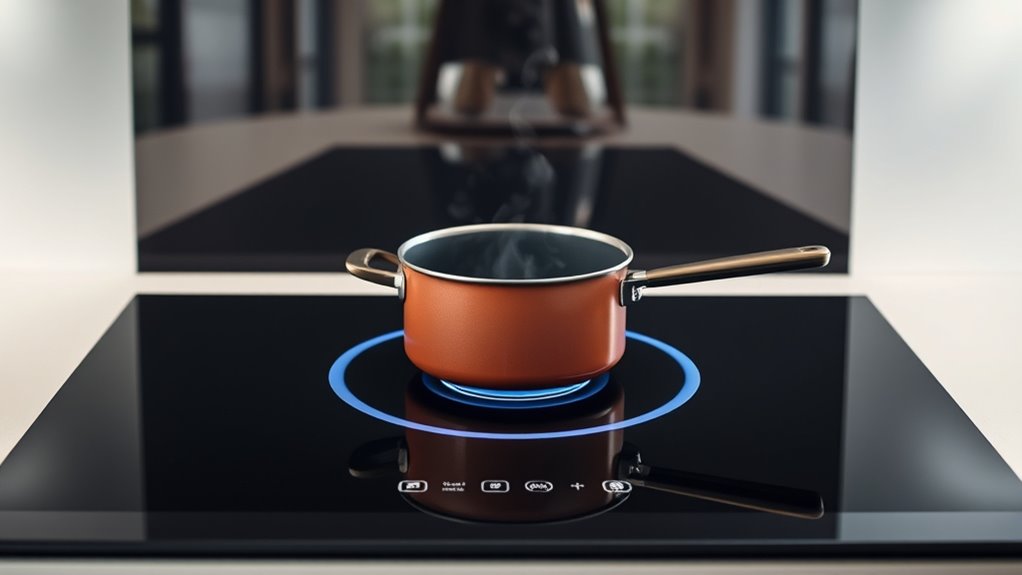
Although induction cooktops look like traditional stoves, they generate heat differently by using electromagnetic fields. When you turn on an induction cooktop, copper coils beneath its surface create an alternating magnetic field.
This field interacts only with induction compatible cookware that has a ferrous metal base, such as magnetic steel. When you place ferrous cookware on the cooktop, the magnetic field induces electrical currents in the metal base, causing rapid heat generation directly within the cookware.
Unlike conventional stoves, the cooktop’s surface stays cool because heat transfer happens inside the pot or pan itself.
You’ll notice that non-magnetic materials won’t heat up since they don’t respond to the magnetic field, emphasizing the importance of using the right induction compatible cookware for efficient cooking.
Materials Compatible With Induction Cooking
Since induction cooktops rely on magnetic fields to generate heat, you need cookware made from ferrous metals like stainless steel or cast iron to cook effectively.
Induction-compatible pots and pans must have a magnetic base that allows the cooktop to transfer energy.
A magnetic base is essential for induction cookware to efficiently transfer energy from the cooktop.
Stainless steel and cast iron are common ferrous metals used because they’re naturally magnetic. Many stainless steel sets include magnetic stainless steel cores or bases for compatibility.
On the other hand, materials such as non-magnetic glass, ceramic, aluminum, or copper won’t work unless they’ve a magnetic base attached.
You can easily test your cookware by seeing if a magnet sticks to the bottom. If it does, your cookware will work on an induction stovetop without issue.
Features of Caraway Cookware Bases
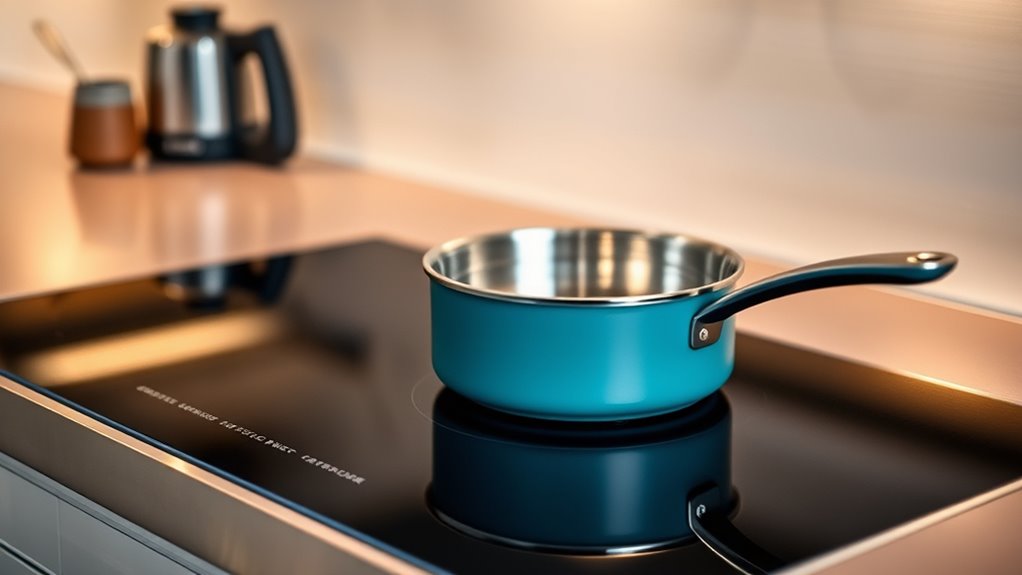
When you use Caraway cookware on an induction stovetop, its magnetic steel base bonded to the aluminum core guarantees efficient heating. This magnetic steel base provides the essential ferrous material needed for induction compatibility, ensuring your cookware responds quickly to the cooktop’s magnetic field.
The aluminum core enhances heat transfer, distributing warmth evenly across the pan. Caraway’s flat bottom surface ensures ideal contact with the induction surface, maximizing effective heat transfer without hotspots.
The magnetic steel layer is seamlessly integrated into the cookware’s exterior, maintaining a sleek look while providing functionality. Additionally, the stainless steel handles offer durability and comfort without affecting induction performance.
Performance of Caraway Cookware on Induction Stovetops
If you use Caraway cookware on an induction stovetop, you’ll find that its stainless steel base bonded to aluminum allows for effective heating. The magnetic steel base guarantees the pans are induction-compatible, providing generally even heating across the surface.
However, the performance can vary depending on your stovetop and how flat the bottoms are. Some users have reported that slightly warped or uneven bases cause hot spots or reduce heating efficiency.
To get the best results, make sure your Caraway cookware has flat bottoms for proper contact with the induction surface. While Caraway pans typically heat quickly and evenly, the key to reliable performance lies in avoiding warped bases and ensuring solid stovetop contact.
Impact of Cookware Bottom Flatness on Induction Efficiency
Although induction cooktops excel at rapid heating, they rely heavily on cookware with perfectly flat bottoms to maintain efficient heat transfer. If your cookware’s bottom isn’t flat, such as warped cookware or one with an uneven aluminum base, you’ll experience poor induction compatibility.
Gaps between the cookware and the cooktop reduce heat transfer, causing uneven heating and creating hot spots that can ruin your meal. To get the best results, make sure your cookware sits firmly on a level surface.
Even slight imperfections in the flat bottom impact induction efficiency markedly. When using Caraway, check the steel base bonded to the aluminum for flatness, as any warping will reduce cooking performance on induction stoves.
Prioritize cookware with a smooth, flat bottom for ideal heat transfer and consistent cooking.
Comparing Caraway to Other Induction-Ready Cookware
Cookware bottom flatness directly affects how well your pots and pans perform on induction cooktops, and Caraway is no exception. When comparing Caraway to other induction-compatible cookware, keep these points in mind:
- Caraway combines a stainless steel base with aluminum pots for efficient heat conduction on induction stovetops.
- Unlike some nonstick cookware lacking a magnetic layer, Caraway’s design ensures solid induction performance.
- Some users note Caraway’s flat bottoms aren’t always perfect, which can slightly impact performance compared to brands like All-Clad or Le Creuset.
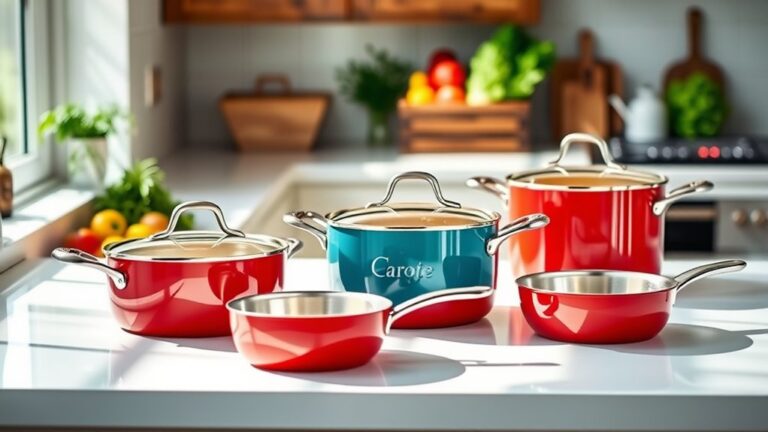
- Caraway stands out by offering colorful, stylish options without sacrificing induction compatibility.
Tips for Optimizing Caraway Use on Induction Ranges
When you use Caraway on induction ranges, ensuring the pan’s bottom fully touches the cooktop helps maximize heat transfer and cooking efficiency.
Thanks to its stainless steel base bonded to aluminum cookware, Caraway is fully compatible cookware for induction stovetops.
To protect the ceramic nonstick coating, always preheat your pan on low to medium heat rather than high heat settings. This prevents uneven heating and extends the life of the nonstick surface.
Make sure your induction cooktop recognizes the pan, usually indicated by a sound or light, to confirm proper contact.
Avoid sliding the cookware abruptly to maintain the integrity of the stainless steel base.
Following these tips will help you get the most out of your Caraway cookware on induction stovetops while preserving its performance and durability.
User Experiences With Caraway on Induction Cooktops
Since Caraway pans feature a stainless steel base, many users find they work well on induction cooktops, effectively activating the burners. The magnetic steel layer ensures your induction cooktop recognizes the cookware quickly.
However, your user experience may vary depending on the pan’s flat bottom and thickness, which impact even heating. Some users notice that Caraway requires higher heat settings for excellent performance compared to traditional pans.
Here’s what you should know from user feedback:
- The stainless steel base activates induction burners efficiently.
- Flat, smooth bottoms improve contact and even heating.
- Uneven heating can occur if the pan’s magnetic steel layer is thin or uneven.
- High heat settings might be necessary for certain cooking tasks.
Frequently Asked Questions
Do Caraway Pans Work on an Induction Stove Top?
Yes, Caraway pans work on induction stovetops because they have a magnetic steel base bonded to aluminum.
You’ll get even heating, but make sure your pan’s base is flat and thick for the best performance.
Can I Use Ceramic Cookware on an Induction Cooktop?
About 90% of ceramic cookware won’t work on induction cooktops. You need ceramic with a magnetic base or test with a magnet—if it sticks, you’re good to go.
Otherwise, it won’t heat properly on induction.
What Are the Negatives of Caraway Cookware?
Caraway cookware can chip, stain, or scratch, and its nonstick coating may wear out faster than traditional pans. You might find cleaning tricky around rivets, and handles or surfaces could discolor with regular use and washing.
Can Caraway Be Used on a Glass Top Stove?
Yes, you can use Caraway on a glass top stove, but guarantee the pan’s bottom is flat and magnetic for proper contact.
Slight curvature might cause uneven heating, so double-check before cooking for best results.
Conclusion
You can count on Caraway cookware to conquer your induction cooktop challenges with confidence. Its carefully crafted core and flat, flawless base foster fantastic heat flow, fueling flavorful feasts without fuss.
By choosing Caraway, you’re selecting seamless synergy between style and stove, ensuring steady, speedy, and successful cooking sessions. So, whether you’re simmering, sautéing, or searing, Caraway consistently delivers dependable, delicious results right on your induction range.
In conclusion, Caraway cookware works exceptionally well on induction stovetops, providing efficient heat distribution and excellent cooking performance every time.